When you’re planning or maintaining structures that extend into navigable airspace, obstruction lighting isn’t optional, but a regulatory requirement. The challenge is figuring out which standards apply. When comparing ICAO vs. FAA lighting requirements, it’s easy to assume that compliance with one automatically covers the other. In reality, that’s not always the case. A lighting system that satisfies global ICAO guidance might still fall short under FAA regulations, and vice versa. In certain situations, you might be expected to comply with both.
- Understanding ICAO and FAA Obstruction Lighting Standards
- Key Differences Between ICAO and FAA Lighting Requirements
- When Dual Compliance Becomes Necessary
- Risks of Failing to Meet Dual Compliance Standards
- Ensure Compliance With Hali-Brite Obstruction Lighting Solutions
Let’s explore how ICAO vs. FAA obstruction lighting standards differ and when dual compliance becomes necessary.
Understanding ICAO and FAA Obstruction Lighting Standards
The International Civil Aviation Organization (ICAO) is a United Nations agency that sets global aviation standards used by most countries. Its guidance is designed to promote consistency across borders, so pilots flying internationally can expect similar visual cues during operations. ICAO standards are adopted and enforced by individual countries through their national aviation authorities.
The Federal Aviation Administration (FAA), on the other hand, regulates civil aviation within the United States. FAA rules are legally binding under U.S. law and are often more detailed and prescriptive than international guidance. When you are working on a project in U.S. airspace, FAA requirements are not optional, even if the structure affects international flight paths.
Both ICAO and FAA obstruction lighting standards exist for the same reason, and that’s to make obstacles visible so pilots can avoid them. Obstruction lights mark towers, buildings, cranes, and other vertical hazards, especially at night or in low-visibility conditions. The reason standards differ is simple: ICAO designs for global consistency, while the FAA designs for the specific operating environment of U.S. airspace, infrastructure, and enforcement practices.
Key Differences Between ICAO and FAA Lighting Requirements
Both ICAO and the FAA regulate aviation obstruction lighting based on color, intensity, and flash characteristics. However, the technical details can vary in ways that directly affect equipment selection and system design.
FAA Obstruction Lighting Requirements
The FAA defines obstruction lighting through specific fixture types. Each type has fixed photometric requirements, flash rates, and operating modes. FAA lighting systems are tightly controlled to ensure predictable visibility under U.S. operating conditions.
| Light Type | Color | Flash Pattern | Intensity |
| L-810 | Red | Steady | 32.5 cd |
| L-810 (F) | Red | Flashing (30 fpm) | 32.5 cd |
| L-864 | Red | Flashing (30 fpm) | 2,000 cd (peak);
750 cd (minimum) |
| L-865 | White | Flashing (40 fpm) | 20,000 cd (day/twilight);
2,000 cd (night) |
| L-856 | White | Flashing (40 fpm) | 270,000 cd (day);
20,000 cd (twilight); 2,000 cd (night) |
| L-857 | White | Flashing (60 fpm) | 140,000 cd (day);
20,000 cd (twilight); 2,000 cd (night) |
FAA rules further specify exact beam spreads, vertical aiming angles, and failure responses. For example, if a flashing system fails, certain FAA lights must default to a steady or alternate flashing mode to maintain visibility. These requirements are detailed and equipment-specific.
ICAO Obstruction Lighting Requirements
Instead of prescribing equipment models, the ICAO classifies obstruction lighting systems into intensity categories. These standards are designed to work across different countries, climates, and technologies while maintaining visual recognition for pilots worldwide.
| Light Type | Color | Flash Pattern | Intensity |
| Low-Intensity Type A | Red | Fixed | 10 cd |
| Low-Intensity Type B | Red | Fixed | 32 cd |
| Medium-Intensity Type A | White | Flashing (20 to 60 fpm) | 20,000 cd (day);
20,000 cd (twilight); 2,000 cd (night) |
| Medium-Intensity Type B | Red | Flashing (20 to 60 fpm) | 2,000 cd (night) |
| Medium-Intensity Type C | Red | Fixed | 2,000 cd (night) |
| High-Intensity Type A | White | Flashing (40 to 60 fpm) | 200,000 cd (day);
20,000 cd (twilight); 2,000 cd (night) |
| High-Intensity Type B | White | Flashing (40 to 60 fpm) | 100,000 cd (day);
20,000 cd (twilight); 2,000 cd (night |
ICAO allows more flexibility in how obstacles are visually identified. In some cases, physical markers or symbols, such as a lighted X on closed or restricted structures, might supplement or replace lighting depending on operational needs. The goal is immediate recognition rather than strict equipment conformity.
Key Differences Between ICAO vs. FAA Lighting Requirements
The FAA standards are highly prescriptive, defining exact light models, intensities, flash rates, and failure behaviors. The ICAO standards, on the other hand, are more performance-based, allowing states to choose how to meet the required visibility outcomes. Furthermore, the FAA rules are designed specifically for U.S. airspace and often prioritize compatibility with domestic flight operations and infrastructure, while the ICAO standards act as a global baseline, adopted by countries and sometimes modified locally. Because of these differences, a lighting system that complies with ICAO might not automatically meet FAA requirements.
When Dual Compliance Becomes Necessary
Dual compliance becomes necessary when an airport operates at the intersection of domestic and international aviation activity. Even if the airport is located entirely within the United States, international carriers expect obstacle lighting that aligns with ICAO standards recognized worldwide. In these cases, relying only on FAA rules might not be enough, and you often need to evaluate ICAO vs. FAA lighting requirements side by side to ensure pilots approaching from different jurisdictions receive consistent visual cues.
Structures near border regions or shared airspace further trigger dual compliance concerns. Tall towers, wind turbines, bridges, and cranes close to international boundaries can affect aircraft transitioning between airspaces. What meets FAA standards might not fully align with ICAO expectations for color, flash pattern, or visual marking, particularly when a specific obstacle configuration is used. If your structure is visible to international traffic, you might be expected to meet both standards, even if only one authority has formal enforcement power.
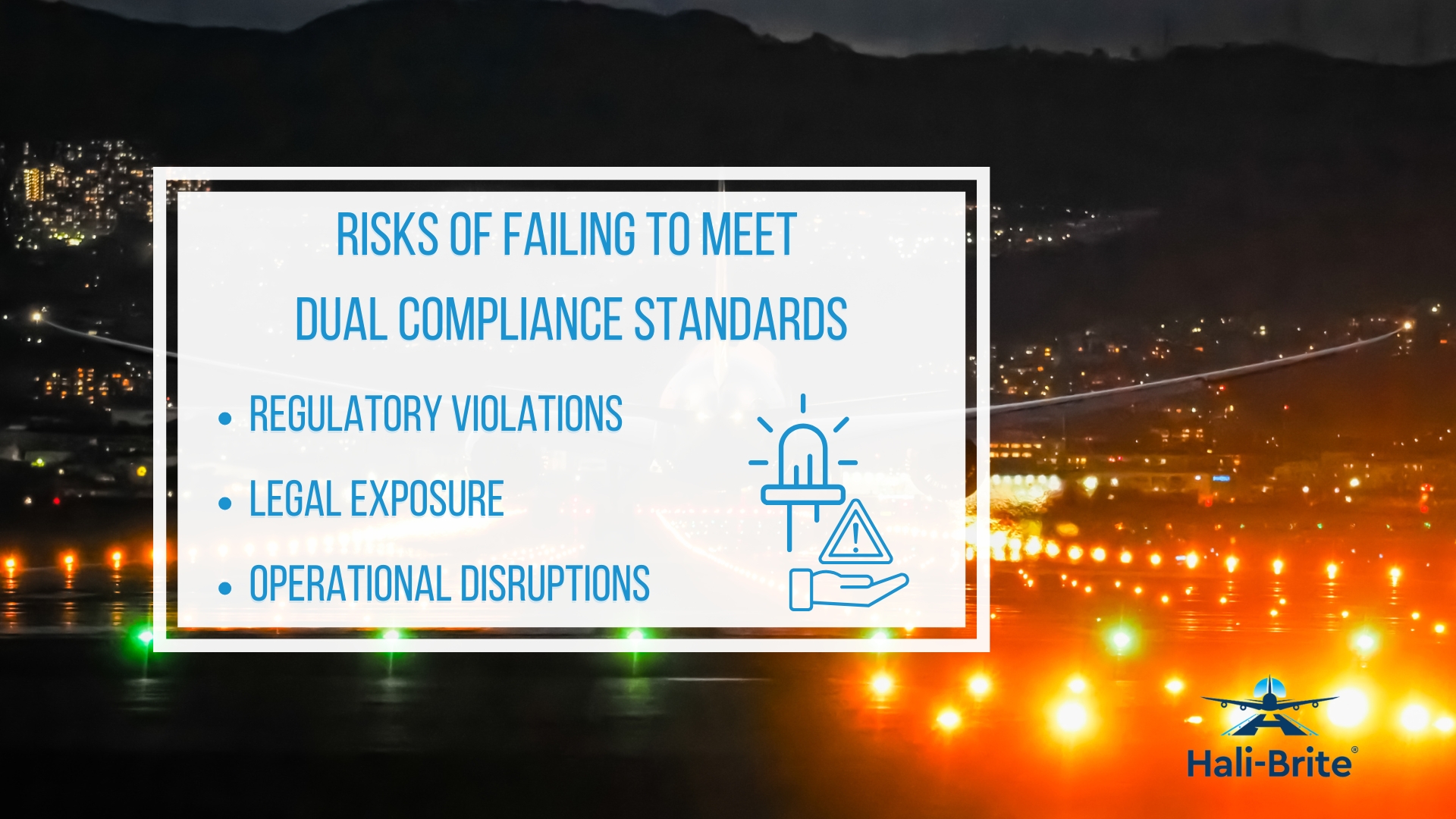
Risks of Failing to Meet Dual Compliance Standards
When ICAO and FAA standards both apply, meeting only one set of rules can expose you to serious problems. Even if your lighting system passes an initial review, gaps between ICAO vs. FAA expectations can surface later during inspections or operational audits. Here are the common risks operators and owners face when dual compliance is overlooked:
Regulatory Violations
Regulatory violations often start with failed inspections. A lighting system that meets FAA intensity or flash requirements might still fall short of ICAO visibility or recognition standards. Inspectors might flag issues, such as incorrect color transitions, improper flash sequencing, or missing visual cues used internationally. These failures can delay approvals, require retrofits, or force temporary shutdowns until corrections are made.
Legal Exposure
Liability increases when obstruction lighting does not meet all applicable standards. If an incident occurs and investigators determine that lighting failed to align with recognized international guidance, responsibility might shift to the owner or operator. Courts and insurers often look at whether you followed both national and international best practices. Inadequate consideration of ICAO vs. FAA lighting requirements can weaken your legal position.
Operational Disruptions
Airports and structures tied to aviation operations might face grounding orders, restricted operations, or reduced flight approvals if lighting is found noncompliant. For international facilities, that can mean canceled routes or lost traffic. Even temporary fixes, such as installing a lighted X to mark unusable structures or areas, can disrupt normal operations and impact revenue. These disruptions can be far more expensive than designing for dual compliance from the start.
Ensure Compliance With Hali-Brite Obstruction Lighting Solutions
If you want confidence that your airport lighting systems meet both U.S. and international expectations, work with a team that understands the details. Hali-Brite is ready to help. We offer FAA- and ICAO-compliant airfield lighting products, including aviation obstruction lights, lighted X fixtures, wind cones, and more, designed to deliver consistent recognition and reliable performance. Contact us today at (218) 454-0956 or here to discuss your project and find the right lighting solutions for your facility.