

As the use of helicopters grows, the demand for safe and reliable heliports rises as well. The Federal Aviation Administration (FAA) sets specific standards that guide how heliports should be designed and illuminated to keep both pilots and the public safe. These standards are especially important in 2025, as more hospitals, urban centers, and private facilities incorporate heliports into their infrastructure. Let’s explore what you need to know to stay compliant.
- Why Heliport Lighting Matters for Aviation Safety
- FAA Standards for Heliport Lighting in 2025
- Why Choose Hali-Brite for Heliport Lighting Solutions
Why Heliport Lighting Matters for Aviation Safety
When a helicopter approaches for landing, heliport lighting aids ensure that the pilot can clearly see the Touchdown and Liftoff Area (TLOF), Final Approach and Takeoff Area (FATO), and the surrounding safety zone. Without well-placed lighting, even experienced pilots face considerable risks during low visibility and nighttime operations.
For takeoff, lighting helps pilots confirm their orientation, avoid obstacles, and align with designated approach or departure paths. During landing, it provides clear cues that guide the aircraft safely to the ground, even in challenging weather conditions. Navigation lighting around taxiways, parking areas, and walkways prevents accidents on the ground, ensuring that helicopters and personnel can move safely within the heliport.
Medical helicopters, for instance, often operate in life-or-death situations. Proper lighting ensures that pilots can safely land on hospital helipads at any hour, regardless of nearby city lights or weather interference. In urban settings, where tall buildings and other obstacles complicate operations, heliport lighting systems provide the visibility needed to reduce risks and protect both passengers and surrounding communities.
FAA Standards for Heliport Lighting in 2025
The FAA Advisory Circular 150/5390-2D, updated in January 2023, lays out the current standards for heliport design, including heliport lighting requirements. These rules ensure pilots have the visibility needed during takeoff, landing, and taxiing, even in tough conditions.
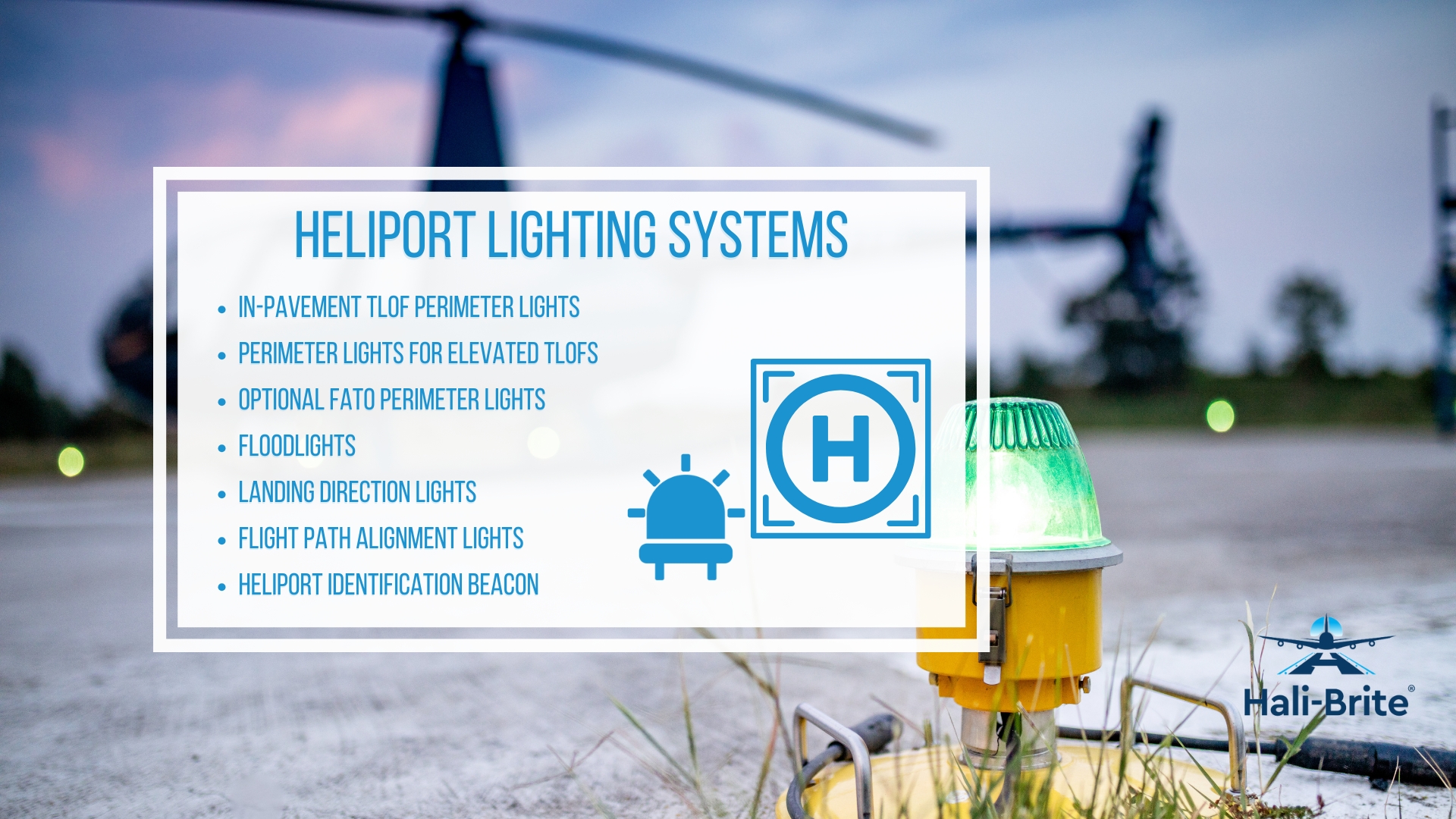
In-Pavement TLOF Perimeter Lights
In-pavement perimeter lights outline the TLOF when it’s located at ground level or flush with the surface. These lights help pilots identify the precise landing zone during approach and ensure visibility even when ambient lighting is poor. Under FAA AC 150/5390-2D, in-pavement TLOF perimeter lights must emit green light, spaced evenly at a maximum of 25 feet around the TLOF. Their intensity must be strong enough to be visible from a distance but not so bright that it blinds pilots during approach.
Perimeter Lights for Elevated TLOFs
Elevated TLOFs are common on rooftops or raised platforms. Since there’s no surrounding pavement, elevated lights must clearly outline the safe landing zone from all approach angles. The FAA requires that elevated TLOF perimeter lights, installed around the entire pad, do not penetrate a horizontal plane at the TLOF edge elevation by more than 2 inches. Our L-860 Low Intensity Elevated Runway Heliport Light features a low-wattage incandescent lamp that produces enough heat to keep snow and ice from building up, ensuring year-round visibility.
Optional FATO Perimeter Lights
While not mandatory, FATO perimeter lights can help pilots better align during final approach or departure, especially at heliports with multiple operational directions. When used, FATO lights must be green and spaced at intervals of no more than 25 feet along the perimeter. These lights should not create visual confusion with TLOF lighting, so proper spacing and separation are necessary. Moreover, FAA guidelines caution against excessive lighting that can overwhelm pilots during nighttime operations.
Floodlights
Floodlights serve as supplemental lighting for heliports, especially where ambient light is limited. These fixtures provide broad area illumination over the TLOF and the surrounding safety zone so pilots can see obstacles and ground crews can safely operate. Floodlights must be steady and glare-free, directed downward to prevent light pollution or interference with neighboring properties. The FAA recommends using floodlights that are fully controllable, either manually or automatically, to adjust to operational needs.
Landing Direction Lights
Landing direction lights indicate the preferred landing direction when multiple approach options exist. These are particularly useful at hospital or transport heliports where wind and obstacle conditions might change frequently. FAA requirements specify that landing direction lights must consist of five green, omnidirectional lights located on the centerline of the preferred approach or departure paths. Placement must ensure these lights are clearly distinguishable from other heliport lighting and avoid interfering with FATO or taxi route lights.
Flight Path Alignment Lights
Flight path alignment lights are designed to guide pilots along the intended approach or departure path. These lights show the correct line of travel, reducing the risk of veering off course. The FAA AC 150/5390-2D provides that flight path alignment lights must be installed in a straight line aligned with the direction of the approach or departure flight path. Each setup must use three or more green lights, spaced between 5 feet and 10 feet apart, ensuring consistent visibility and alignment cues for incoming or departing helicopters.
Heliport Identification Beacon
A heliport identification beacon helps pilots locate the heliport from a distance. It’s often installed on a nearby tower, roof, or tip-down pole, flashing a white/green/yellow light pattern at a rate of 30 to 45 flashes per minute. The beacon must be clearly visible from at least one mile under normal visibility conditions and mounted high enough to avoid obstructions but not interfere with flight paths.
Our Heli-Port LED Rotating Beacon L-801(H)L uses energy-efficient LED lighting with a 50,000-hour lamp life and cuts power usage by 80% compared to traditional metal halide lamps. It provides instant-on capability, so no waiting for bulbs to reach full brightness. The patented belt-drive system eliminates lubrication needs, and it can be mounted on our Beacon Tipdown Pole for easy maintenance.
Why Choose Hali-Brite for Heliport Lighting Solutions
Hali-Brite has built a nationwide reputation for delivering dependable, FAA-compliant lighting solutions that combine practical design with modern technology. Our heliport lighting products are built to withstand harsh weather, offer long-lasting performance, and meet or exceed the latest FAA requirements, ensuring your heliport operates smoothly in 2025 and beyond. For your aviation needs, contact us today at (218) 454-095 or here.