
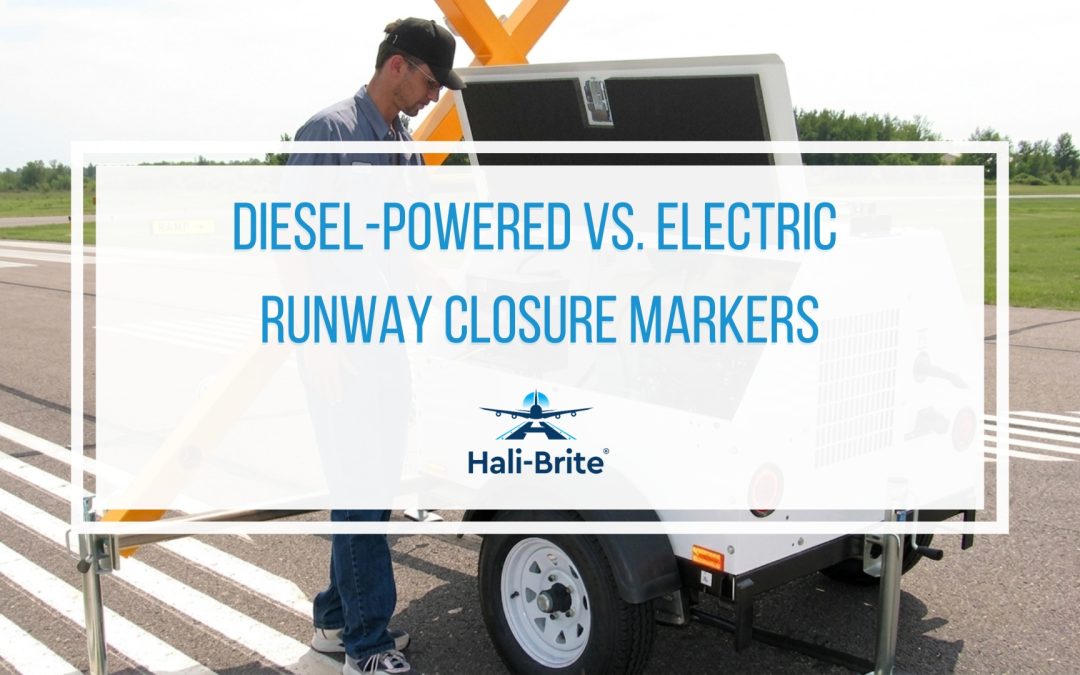
When a runway or taxiway is closed, clear visual communication becomes a safety priority. Pilots need to know right away that a surface is unavailable, especially during low visibility, night operations, construction work, emergency repairs, or temporary airfield changes. A runway closure marker provides pilots with a clear “X” signal to help prevent confusion, wrong-surface landings, and unsafe movement into restricted areas.
- What Runway Closure Markers Are Designed to Do
- How Diesel-Powered Closure Markers Operate
- How Electric Closure Markers Compare
- Key Operational Tradeoffs Between Diesel and Electric Systems
- Choosing the Right Closure Marker for Your Airfield
For airport operators, the choice of closure marker often comes down to visibility, power source, mobility, maintenance, response time, fuel use, and long-term operating cost. A diesel closure marker and an electric closure marker can both serve the same basic purpose, but do it in different ways. Each option has tradeoffs depending on your airfield layout, closure duration, available power, and response needs.
Let’s explore how diesel-powered and electric closure markers differ, what each system offers, and what tradeoffs airport operators should consider before choosing one.
What Runway Closure Markers Are Designed to Do
A runway closure marker is designed to clearly indicate that a runway, taxiway, or part of a movement area is not available for aircraft use. Its main job is to give pilots a high-visibility “X” marking that can be seen from a long distance, helping them identify closed surfaces before landing, taking off, or taxiing. Note that the International Civil Aviation Organization (ICAO) has updated its guidance for closed runway and taxiway markings under Annex 14, Volume I, Amendment 18, with updates related to visual aids and temporary runway closures to improve situational awareness for pilots.
Runway closure markers support both planned and emergency closures. For example, you might need to close a runway during pavement repairs, airport lighting maintenance, snow-related closures, aircraft incidents, construction activity, or temporary operational changes. In these situations, closure markers help reduce confusion and prevent aircraft from using a surface that’s unsafe or unavailable. Since closures might happen in daylight, darkness, harsh weather, or low-visibility conditions, the marker must be bright, easy to recognize, and positioned in a way that supports safe airfield operations.
How Diesel-Powered Closure Markers Operate
A diesel-powered closure marker, such as our LED Portable Lighted Runway Closure Marker RCM-D L-893, is built for situations where you need strong lighting, reliable runtime, and operation without depending on nearby electrical service. These units are often used in temporary closures, remote airfield areas, construction zones, and emergency response situations where quick deployment matters.
Built-In Power
A diesel closure marker uses an onboard engine to power its lighting system. Instead of requiring a direct electrical connection, the unit carries its own power source, making it useful for areas far from available infrastructure, airfields with large layouts, remote runway ends, temporary construction zones, or locations where utility power has not yet been installed. Simply place the marker where it is needed, start the engine, and establish the closure signal without waiting for the electrical setup.
High-Output Illumination
Diesel-powered closure markers are often valued for high-output illumination. Their lighting systems are designed to make the “X” marking visible from long distances, giving pilots enough time to recognize that the surface is closed. That’s especially helpful at night, during reduced visibility, or in situations where a closed runway could otherwise appear active from the air. When the marker is bright and properly positioned, it reduces the risk of confusion and supports safer decision-making.
Independent Operation
A diesel closure marker is a practical choice for locations where the electrical grid is limited, unavailable, damaged, or inconvenient to access. If the airport is dealing with temporary construction, power interruptions, remote work areas, or emergency closures, the marker can often be deployed quickly and operated independently. The tradeoff is that diesel units require fuel management, engine maintenance, and regular checks to ensure the markers remain ready for use when needed.
How Electric Closure Markers Compare
Electric closure markers serve the same basic purpose as diesel-powered units, but operate in a different way. Instead of relying mainly on an onboard engine, an electric closure marker may use external power, battery power, or a combination of both, making it a practical choice for airports that want cleaner operation, less noise, and fewer mechanical maintenance needs.
Power Connection
An electric marker depends on an available power source or a charged battery system. If the unit connects to external power, you need the right electrical infrastructure near the closure area. If the unit uses batteries, you need to consider charge time, battery capacity, and how long the marker can operate before power runs low. The setup can work well for planned closures where power access is already available.
Clean and Quiet Operation
Since an electric closure marker does not need to run a diesel engine during use, it can reduce on-site emissions. That can be a substantial benefit if you want to lower fuel use or reduce the environmental impact of temporary closures. Furthermore, electric systems are quieter. A quiet operation can be helpful for airports near residential areas, nighttime operations, or crews working close to the marker for long periods.
Simple Components
Electric units have fewer moving mechanical parts compared to diesel-powered systems, and that can simplify operation and reduce some maintenance needs. Without an onboard diesel engine running during use, there are fewer engine-related service tasks, such as fuel system checks and engine repairs. A simpler system often means faster startup, less mechanical monitoring, and fewer steps for trained personnel.
Runtime Limits
Runtime relies on the power system available. A battery-powered unit can only operate as long as its battery has enough charge. An externally powered unit can run longer, but only if the electrical source remains available and stable. Moreover, portability might be limited. If you need to place the marker far from electrical access, you might need longer cables, temporary power equipment, or a different deployment plan.
Key Operational Tradeoffs Between Diesel and Electric Systems
The biggest tradeoff between diesel and electric systems often comes down to mobility and power access. A diesel closure marker gives you strong deployment flexibility because it can operate independently with fuel, making it useful for emergency closures and temporary airfield projects. An electric closure marker can be cleaner, quieter, and simpler to operate, but it depends heavily on electrical infrastructure or battery capacity. If your airfield has reliable power where closures usually happen, an electric option might be efficient. If your closures are unpredictable, diesel power might offer more flexibility.
Some closure markers are designed to give you the benefits of both systems. Our LED Portable Lighted Runway Closure Marker RCM-D-ICAO, for example, uses a reliable diesel engine with shore power capability. At the same time, the Lighted X can be powered from an external power source. For added reliability, it can include an optional 24-hour battery backup, where the Lighted X automatically switches over to battery power when generator power is lost. Its hybrid setup helps you get the independence of a diesel closure marker while still supporting the flexibility and backup benefits associated with an electric unit.
Choosing the Right Closure Marker for Your Airfield
Choosing the right closure marker starts with understanding the actual operating conditions of your airfield. Consider where the marker will be used, how often closures happen, how long closures usually last, and whether reliable power is available near the closure area. Long-term operating costs matter, including fuel, maintenance, electrical setup, battery replacement, crew time, and downtime risk. Remember, the best choice is not always the cheapest upfront option. It’s the one that delivers dependable performance, supports compliance, and aligns with how your airport operates.
Hali-Brite can provide you with reliable, FAA-compliant airport lighting products designed for real airfield demands. We can help you evaluate your site conditions, power availability, runtime needs, and maintenance expectations. If you are comparing diesel-powered and electric closure marker systems, or looking for a hybrid-style option with backup power capability, our team can help you select and maintain the right system for compliance, safety, and long-term performance. Contact us today at (218) 454-095 or here to discuss your airfield needs and find the lighting solution for your operation.