

Temporary runway or taxiway closures require clear communication both on the ground and from the air. Construction, pavement repairs, maintenance, snow removal, emergencies, and other operational needs can put a surface out of service for hours, days, or longer. During that time, pilots approaching the airport need a clear visual indication that the affected area is unavailable. Runway closure markers are part of the visual communication system that helps pilots recognize a closure from a distance, particularly during nighttime operations or conditions when an unlighted marking might be harder to identify.
- Why Runway Closure Marker Reliability Matters
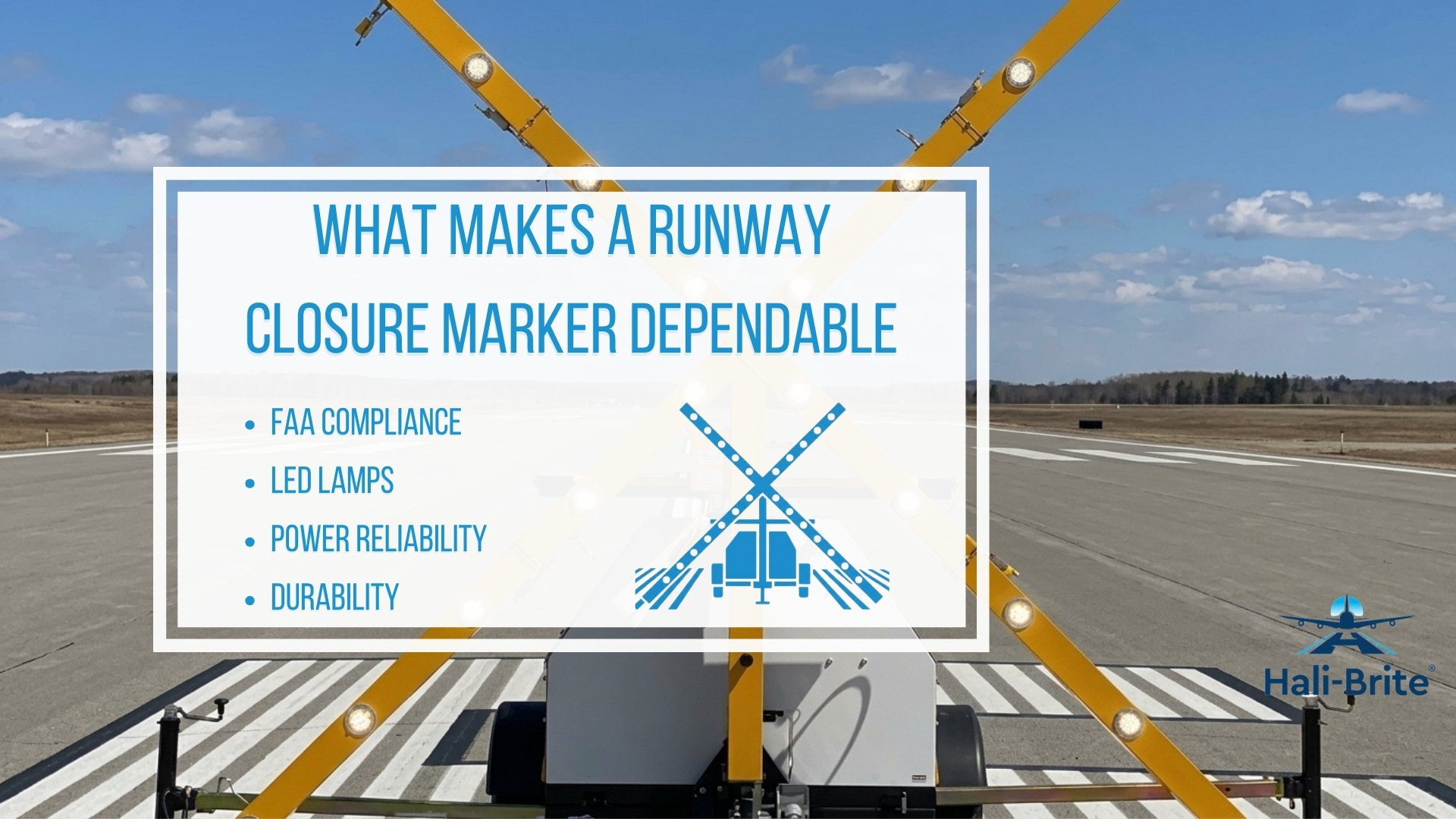
- What Makes a Runway Closure Marker Dependable
- Understanding the Total Cost of Ownership
- How the Hali-Brite RCM-D L-893 Supports Long-Term Value
- Choose a Runway Closure Marker Built for Reliable Airfield Operations
Let’s explore why runway closure marker reliability matters, what makes a system dependable, and how total cost can help you choose the right equipment for your airfield.
Why Runway Closure Marker Reliability Matters
Lighted closure markers give pilots a highly visible indication that a runway is temporarily closed and can further be used to warn of closed taxiways where appropriate. For runways, the familiar lighted X provides a direct visual cue from the direction of approach, helping reinforce closure information before an aircraft reaches the pavement. The Federal Aviation Administration (FAA) classifies the L-893 as a lighted visual aid for temporary runway closures, particularly useful during reduced visibility or nighttime operations when airports need a portable marker for maintenance, construction, or other operations.
Pilots must be able to recognize a runway closure marker quickly and without unnecessary uncertainty. A marker that fails to illuminate, runs out of fuel unexpectedly, shifts out of position, or requires frequent repairs can extend downtime and create additional operational concerns. Airport personnel might need to interrupt other work to inspect or restore the equipment, and a faulty unit might have to be replaced or supplemented before operations can continue as planned. Having reliable equipment from the start can help reduce those disruptions and support a clear, consistent indication of the closure.
What Makes a Runway Closure Marker Dependable
Reliability comes from several parts of the system working together. When you evaluate runway closure markers, consider how well the marker meets applicable standards, produces consistent light, operates independently, and handles the physical demands of an airfield environment.
FAA Compliance
The FAA establishes guidance for the design of a lighted visual aid used to indicate a temporary runway closure. For certain federally funded airport development projects, applicable FAA standards can be mandatory. Choosing an FAA-certified runway closure marker gives you a defined performance baseline and simplifies specification decisions for projects that require compliant airfield equipment.
LED Lamps
LEDs can significantly reduce the frequency of routine lamp replacement compared with older lighting technology. Our RCM-D L-893, for example, uses built-in LED lamps with a rated life of 50,000 hours. Longer lamp life can mean fewer replacement parts to stock, fewer maintenance visits, and less risk that a failed lamp interrupts use when a runway closure marker is required.
Power Reliability
An onboard generator allows the runway closure marker to operate independently during temporary closures and changing work zones. Fuel capacity and consumption must be evaluated together with runtime. Shore-power compatibility can add flexibility when external electricity is available, while backup power can provide another layer of protection if the primary system shuts down.
Durability
Airfield equipment is often exposed to harsh weather, towing, repeated deployment, uneven surfaces, and outdoor storage, so physical construction matters as much as lighting output. Look for wind resistance, sturdy construction, leveling support, and a trailer designed for transportation. These features keep the marker stable and usable outdoors while being practical to move.
Understanding the Total Cost of Ownership
The purchase price is only a part of what a runway closure marker actually costs over its service life. A lower-priced unit might seem attractive until frequent maintenance, hard-to-source parts, unexpected repairs, or limited runtime start to add to the expense. Downtime can be even more costly if a failed marker delays work or forces personnel to arrange another compliant airfield closure solution. When you compare runway closure markers, account for how long the temporary closure lasts, how easily your team can service the system, and what support is available for replacement parts. The better value is often the marker that can perform consistently with less downtime and fewer interruptions, not simply the one with the lowest initial price.
How the Hali-Brite RCM-D L-893 Supports Long-Term Value
The Hali-Brite RCM-D L-893 combines several features designed to support reliable operation and manageable lifecycle costs. Its lighted X uses 20 forward-facing LED spotlights, with visibility of approximately 10 to 25 miles from the runway under VFR conditions. The diesel-powered system has a fuel consumption rate of about 0.4 gallons per hour and provides more than 140 hours of runtime. One person can set up the marker in less than five minutes without tools, helping reduce deployment time and labor demands. When transportation or storage is required, the light assembly folds into a compact configuration. Together, these features can help reduce routine service demands, make the equipment easier to deploy and maintain, and keep it ready for temporary closures.
Choose a Runway Closure Marker Built for Reliable Airfield Operations
When choosing a runway closure marker, evaluate compliance, visibility, runtime, durability, setup requirements, and maintenance as one complete operating picture. Then compare those factors against the expected service life of the equipment. Do not make a decision based solely on the initial purchase price. An efficient power system, long-life lighting, quick deployment, stable construction, and readily available service options can all reduce ownership costs over time. If you only need markers for a short construction project, seasonal maintenance, or occasional closures, equipment rental might be an option.
Hali-Brite provides FAA-certified airport lighting solutions, including our RCM-D L-893, a portable, high-visibility runway closure marker designed for dependable airfield use, with available accessories that let you adapt the equipment to your operating needs. Its optional 24-hour Battery Backup, for instance, automatically switches the lighted X to battery power when generator power is lost or turned off manually. We offer rental options for temporary airfield needs. Contact us today at (218) 454-0956 or here to discuss your runway closure requirements. Let us help you find a solution that fits your operation.